

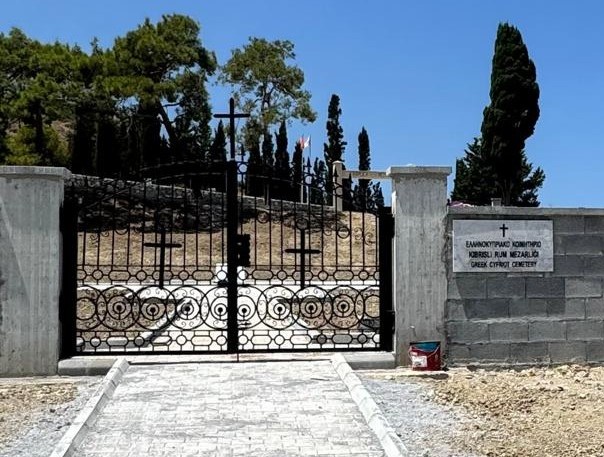
Chris was recently in the occupied areas of Cyprus – in particular, the ancestral seat at Davlos on the beautiful northern coast – and was pleasantly surprised to see that there has been an attempted restoration of the Greek Cypriot cemetery there, where many of Chris’s ancestors were buried.
The restoration came about as a result of a United Nations bi-communal initiative by the “Bicommunal Technical Committee for Cultural Heritage”. It was particularly heartening to hear that many of the current inhabitants of the village raised no objections to the restoration, which is located next to the newer Turkish Cypriot cemetery.
With that in mind, Chris receives lots of enquiries from people wanting to know how to transfer land in the occupied areas of Cyprus that once belonged to relatives – usually parents or grandparents – to their modern-day inheritors.
Chris says that anyone entitled to land in the occupied areas – commonly Greek and Turkish Cypriots, but also British and other nationalities – which was owned by their family before 1974 should consider updating the title entries for properties belonging to their ancestors.
The disruption caused by the war in 1974 has meant that many properties remain registered in the name of the person who owned them at that time, and the title entries have never been updated. This creates a risk that people may lose rights they have over those properties if their entitlement cannot be traced.
The problem is that, as successive generations have passed away, the Land Register in Cyprus has often not been updated. The longer this continues, the more complicated the position becomes. In some cases, people will need to apply for multiple probates involving several generations of inheritors and beneficiaries before the transfers can be completed.
A transfer is at its simplest when the registered owner is still alive. It becomes harder once they have passed away, particularly if they were married at the time of their death, owned only a share of the land or there are multiple beneficiaries.
If there have been several deaths within the chain of beneficiaries – for example, a grandfather died and subsequently a parent died – it becomes more complicated again. Each group of beneficiaries needs to be considered and the transfers may require multiple probates. This can be an expensive process in Cyprus, often more expensive than, for instance, a “simple” UK probate.
In addition to the need for multiple probates, the process is complicated by Cyprus’s “forced heirship” rules. This means that the rules relating to land are not the same as those in the UK, and a UK will does not necessarily determine how the land will pass.
People often say, “But I have a Grant of Probate or Letters of Administration in the UK,” or, “My mother or father left Cypriot land to me in a UK will.”
Chris says: “People don’t realise that a UK grant doesn’t apply in Cyprus and the UK probate rules do not apply to fixed property like land there. A Grant of Probate or Letters of Administration doesn’t protect a potential beneficiary, as the rules governing the distribution of land in Cyprus along forced heirship lines will apply instead.”
“Rules have changed – even where there is a will in the UK specifically mentioning Cyprus land, unless certain rules are applied when making that will, it will be of no consequence.”
Chris goes on to say: “Some people say, ‘Don’t worry, it will all be sorted out.’ But chances are it won’t. Even if steps are taken towards doing that, no government – in this case, the Republic of Cyprus – is simply going to allow people to step up and take legal ownership of land without proving that they have an entitlement.”
In other words, that entitlement needs to be established through the appropriate probate verification process.
So Chris says: “You may as well start going through the legal process now to save the pain later.”


